Publications
Find out about our Team, Projects and more at our University of Queensland website
Group highlights
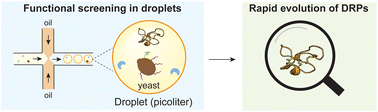
Disulfide-rich peptides (DRPs) have evolved intricate topologies to carry out a wide range of bioactivities throughout nature, e.g., in fungi, insects, plants and animals, and have proven applications in medicine and agriculture. To discover novel DRPs, it is now routine to screen DRP libraries for target affinity, but target binding does not necessarily correlate with function. This study reports an innovative platform for screening of DRP libraries based on the functional endpoint of biochemical reactions within picoliter-sized water-in-oil droplets. We leveraged yeast secretory expression to ensure proper assembly of disulfide connectivity, and thus peptide shape, and engineered customizable strains for facile detection of function (i.e., protease inhibitory activity) for libraries of DRPs. Rapid enrichment of a potent trypsin inhibitor (MCoTI-II) from a >100 000 pool of randomized variants across four rounds of selection was achieved, far exceeding the library sizes explored previously for peptide systems in droplet microfluidics. This developed platform provides a foundation to explore the functional engineering of DRPs.
Jing Xie, Kuok Yap, Simon J de Veer, Selvakumar Edwardraja, Thomas Durek, Matt Trau, David J Craik, Conan K Wang
Lab Chip. 2025 Jul 8;25(14):3525-3536.
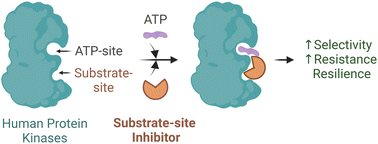
Human kinases are recognized as one of the most important drug targets associated with cancer. There are >80 FDA-approved kinase inhibitors to date, most of which work by inhibiting ATP binding to the kinase. However, the frequent development of single-point mutations within the kinase domain has made overcoming drug resistance a major challenge in drug discovery today. Targeting the substrate site of kinases can offer a more selective and resistance-resilient solution compared to ATP inhibition but has traditionally been challenging. However, emerging technologies for the discovery of drug leads using recombinant display and stabilization of lead compounds have increased interest in targeting the substrate site of kinases. This review discusses recent advances in the substrate-based inhibition of protein kinases and the potential of such approaches for overcoming the emergence of resistance.
Biswajit Biswas, Yen-Hua Huang, David J Craik, Conan K Wang
Chem Sci. 2024 Jul 13;15(33):13130-13147.
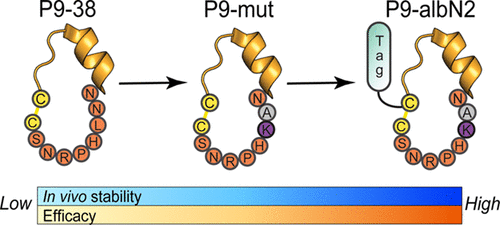
Optimization of peptide stability is essential for the development of peptides as bona fide alternatives to approved monoclonal antibodies. This is clearly the case for the many peptides reported to antagonize proprotein convertase subtilisin-like/kexin type 9 (PCSK9), a clinically validated target for lowering cholesterol. However, the effects of optimization of stability on in vivo activity and particularly the effects of binding to albumin, an emerging drug design paradigm, have not been studied for such peptide leads. In this study, we optimized a PCSK9 inhibitory peptide by mutagenesis and then by conjugation to a short lipidated tag to design P9-alb fusion peptides that have strong affinity to human serum albumin. Although attachment of the tag reduced activity against PCSK9, which was more evident in surface plasmon resonance binding and enzyme-linked immunosorbent competition assays than in cellular assays of activity, activity remained in the nanomolar range (∼40 nM). P9-alb peptides were exceptionally stable in human serum and had half-lives exceeding 48 h, correlating with longer half-lives in mice (40.8 min) compared to the unconjugated peptide. Furthermore, the decrease in in vitro binding was not deleterious to in vivo function, showing that engendering albumin binding improved low-density lipoprotein receptor recovery and cholesterol-lowering activity. Indeed, the peptide P9-albN2 achieved similar functional endpoints as the approved anti-PCSK9 antibody evolocumab, albeit at higher doses. Our study illustrates that optimization of stability instead of binding affinity is an effective way to improve in vivo function.
Yuhui Zhang, Li Wang, Benjamin J Tombling, Carmen Lammi, Yen-Hua Huang, Yue Li, Martina Bartolomei, Bin Hong, David J Craik, Conan K Wang
J Am Chem Soc. 2022 Oct 26;144(42):19485-19498.
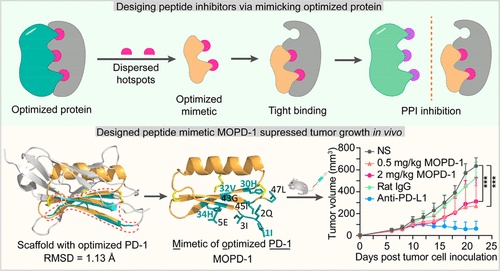
Peptides have potential to be developed into immune checkpoint inhibitors, but the target interfaces are difficult to inhibit. Here, we explored an approach to mimic the binding surface of PD-1 to design inhibitors. Mimicking native PD-1 resulted in a mimetic with no activity. However, mimicking an affinity-optimized PD-1 resulted in the peptide mimetic MOPD-1 that displayed nanomolar affinity to PD-L1 and could inhibit PD-1:PD-L1 interactions in both protein- and cell-based assays. Mutagenesis and structural characterization using NMR spectroscopy and X-ray crystallography revealed that binding residues from the high affinity PD-1 are crucial for the bioactivity of MOPD-1. Furthermore, MOPD-1 was extremely stable in human serum and inhibited tumor growth in vivo, suggesting it has potential for use in cancer immunotherapy. The successful design of an inhibitor of PD-1:PD-L1 using the mimicry approach described herein illustrates the value of placing greater emphasis on optimizing the target interface before inhibitor design and is an approach that could have broader utility for the design of peptide inhibitors for other complex protein-protein interactions.
Huawu Yin, Xiuman Zhou, Yen-Hua Huang, Gordon J King, Brett M Collins, Yanfeng Gao, David J Craik, Conan K Wang
J Am Chem Soc. 2021 Nov 10;143(44):18536-18547.
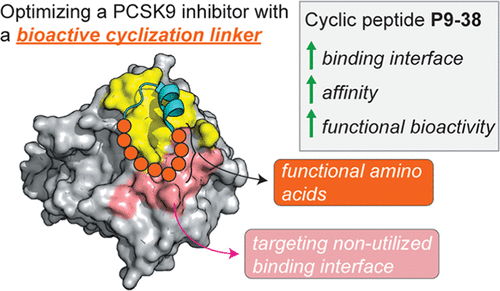
Peptides are regarded as promising next-generation therapeutics. However, an analysis of over 1000 bioactive peptide candidates suggests that many have underdeveloped affinities and could benefit from cyclization using a bridging linker sequence. Until now, the primary focus has been on the use of inert peptide linkers. Here, we show that affinity can be significantly improved by enriching the linker with functional amino acids. We engineered a peptide inhibitor of PCSK9, a target for clinical management of hypercholesterolemia, to demonstrate this concept. Cyclization linker optimization from library screening produced a cyclic peptide with ∼100-fold improved activity over the parent peptide and efficiently restored low-density lipoprotein (LDL) receptor levels and cleared extracellular LDL. The linker forms favorable interactions with PCSK9 as evidenced by thermodynamics, structure-activity relationship (SAR), NMR, and molecular dynamics (MD) studies. This PCSK9 inhibitor is one of many peptides that could benefit from bioactive cyclization, a strategy that is amenable to broad application in pharmaceutical design.
Benjamin J Tombling, Carmen Lammi, Nicole Lawrence, Edward K Gilding, Giovanni Grazioso, David J Craik, Conan K Wang
J Med Chem. 2021 Mar 11;64(5):2523-2533.